3D Spheroid and Organoid Assays
LIDE’s organoid platform provides a flexible and clinically relevant in vitro solution for early-stage drug screening, biomarker discovery, and mechanism-of-action studies. Designed for speed, scalability, and biological fidelity, our 3D spheroid and scaffold-based organoid assays allow researchers to model complex tumor biology with greater accuracy than 2D cultures, without the long timelines of in vivo models.
| Model Type | Definition |
|---|---|
| Organoids (with scaffolding) | 3D tumor structures derived from our CR cells or PDX tissue, cultured in Matrigel or collagen to mimic native ECM |
| 3D Spheroids (scaffold-free) | Self-assembling tumor cell clusters grown in ultra-low attachment (ULA) platesef-ficient, scalable, more cost-effective than organoids |
Why use 3D Spheroids or Organoid Assays?
These models preserve key features of the tumor microenvironment, including cell–cell interaction, architecture, and phenotype, supporting applications across oncology R&D.
| Advantages | Impact |
|---|---|
| Retains tumor heterogeneity | Maintains patient-specific genetic and morphological features |
| Short assay time (7–14 days) | Ideal for early screening or narrowing compound selections |
| Flexible matrix options | Use of Matrigel or collagen for ECM modeling; or scaffold-free for speed |
| Quantitative readouts | Output includes IC₅₀, max/min inhibition, and growth curves |
| Highly reproducible | Suitable for high-throughput screening in 96-well formats |
| Cost-effective | Lower resource burden vs. in vivo PDX models |
These 3D options offer more relevance than 2D assays-and faster time to data than traditional PDX.
LIDE’s Spheroid/Organoid Platform Offering
- PDX-derived Organoids (PDXOs) with or without scaffolding
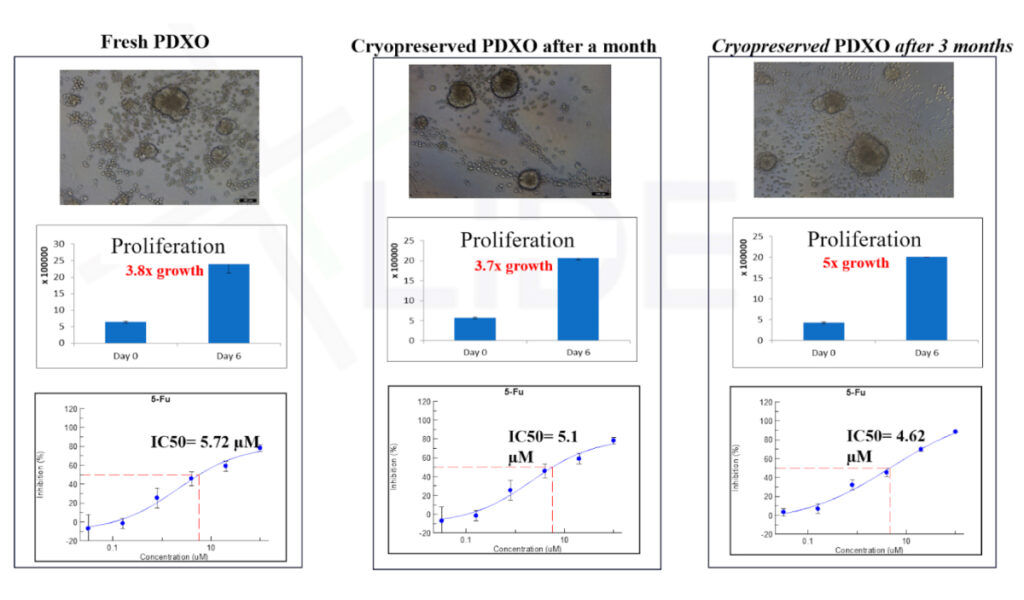
- Frozen PDXO Biobank: 225 models across 21 cancer types, readily available with consistent post-thaw performance
- CR cell-derived Organoids for matched 2D/3D/PDX investigation
- Patient-Derived Organoids (PDOs) from fresh surgical samples
Featured Study: Comparing Biological Fidelity of Frozen PDXO Models
LIDE evaluated the consistency of drug response in frozen PDX-derived organoids (PDXO) over time using an osteosarcoma model and the chemotherapy agent 5-FU.
Result: Despite cryopreservation, proliferation profiles and inhibition curves remained consistent, validating the robustness and utility of LIDE’s frozen PDXO biobank for repeatable, high-confidence in vitro assays.